Executive Summary
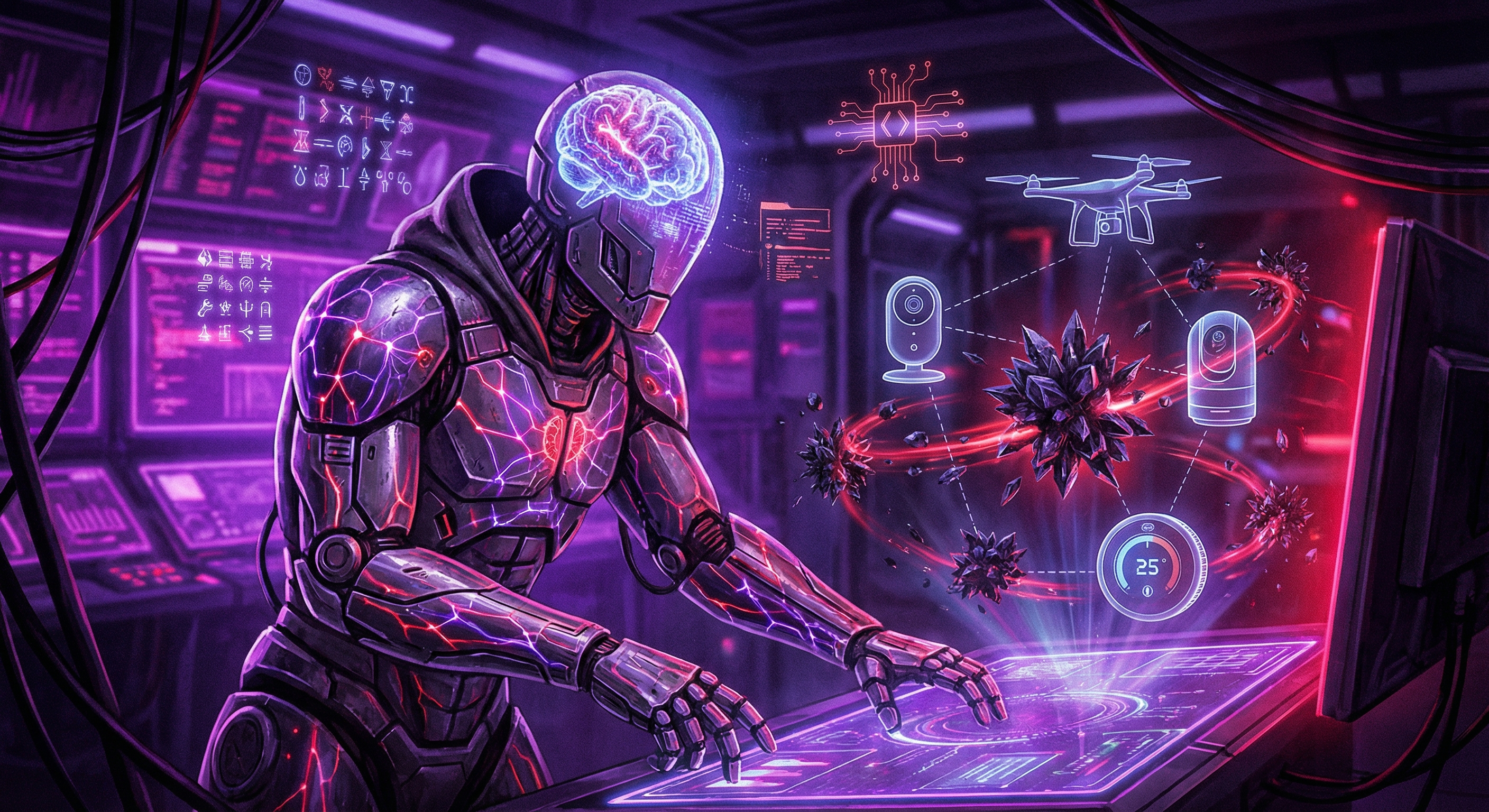
Artificial intelligence has transformed cybersecurity — but not in the way most organizations hoped. While AI promises better defense, it has first become the ultimate weapon for attackers. AI-driven IoT attacks surged 54% in 2026, with autonomous malware that learns, adapts, and evolves faster than human defenders can respond. This isn’t science fiction — it’s the new reality of smart office security. Self-learning botnets now infect devices in minutes, polymorphic malware evades traditional antivirus, and AI-powered reconnaissance scans millions of networks hourly. This comprehensive analysis reveals how AI has weaponized IoT attacks and the cutting-edge defense strategies you need to fight back.
The AI Arms Race: When Machines Attack Machines
For decades, cybersecurity was a human vs. human battle. Hackers wrote exploits, defenders wrote patches. Attackers probed networks manually, defenders monitored logs. Both sides limited by human speed, attention span, and creativity.
That era ended in 2024.
Now, AI-powered attack tools operate at machine speed—scanning millions of targets per hour, adapting exploits in real-time, and coordinating attacks across thousands of compromised devices simultaneously. Traditional defenses, designed for human-speed threats, are overwhelmed.
The New Threat Landscape: By the Numbers
2026 AI-Powered Attack Statistics:
- +54% increase in AI-driven IoT exploit attempts
- +43% surge in AI-powered botnets (self-learning malware)
- +39% rise in AI-based API enumeration attacks
- +61% jump in AI-assisted password cracking
- 49% of IoT reconnaissance scans now use AI
- 32-40 million devices currently infected by AI botnets
- 1.7 Tbps largest AI-coordinated botnet attack (capable of taking down countries)
Why AI Makes Attacks Exponentially More Dangerous
Traditional Attacks:
- Speed: Human-limited (hours to days)
- Scale: Hundreds to thousands of targets
- Adaptation: Manual exploit modification
- Coordination: Pre-programmed scripts
- Evasion: Static signatures (easily detected)
AI-Powered Attacks:
- Speed: Machine-limited (millions per hour)
- Scale: Millions of targets simultaneously
- Adaptation: Real-time exploit evolution
- Coordination: Swarm intelligence (synchronized attacks)
- Evasion: Polymorphic payloads (constantly changing signatures)
The gap isn’t incremental—it’s exponential.
The Five Capabilities That Make AI Attacks Unstoppable
Capability 1: Adaptive Scanning — Finding Vulnerabilities at Machine Speed
How It Works:
Traditional malware scans networks using predefined lists of vulnerabilities. If a device doesn’t match known weaknesses, it’s skipped.
AI-powered scanners learn from every device they encounter:
- Fingerprinting: AI identifies device type, manufacturer, firmware version, OS
- Vulnerability Database: Matches device against known CVE database
- Behavioral Analysis: Probes device responses to identify zero-day vulnerabilities
- Exploit Selection: Chooses optimal exploit from toolkit
- Adaptive Learning: Logs device responses for future attacks
Real-World Example:
In June 2025, an AI scanner identified a previously unknown vulnerability in popular smart doorbell firmware. Within 48 hours, the AI had:
- Scanned 11.2 million IP addresses
- Identified 890,000 vulnerable devices
- Successfully compromised 340,000 devices
- Created a massive botnet before manufacturers even knew about the vulnerability
Traditional scanning would have taken weeks. AI did it in two days.
The Speed Difference:
| Task | Traditional Scan | AI-Powered Scan |
|---|---|---|
| Port scan (1 device) | 3-5 minutes | 2-5 seconds |
| Vulnerability ID | 10-30 minutes | 5-15 seconds |
| Exploit testing | 30-60 minutes | 10-30 seconds |
| Network mapping (50 devices) | 24-48 hours | 15-45 minutes |
Capability 2: Automated Exploit Chains — Real-Time Attack Evolution
The Challenge for Attackers:
Different devices require different exploits. A vulnerability in a smart camera doesn’t work on a smart thermostat. Traditionally, attackers had to manually identify each device and select appropriate exploits.
How AI Solves This:
AI malware carries a toolkit of exploits and autonomously decides which to deploy based on real-time device behavior.
Attack Flow:
Step 1: AI scans device (smart camera detected)
Step 2: Identifies firmware version (v2.3.1)
Step 3: Checks exploit database (3 known vulnerabilities)
Step 4: Tests Exploit A (failed - patched)
Step 5: Tests Exploit B (failed - non-standard config)
Step 6: Tests Exploit C (success - buffer overflow)
Step 7: Payload deployed
Step 8: Device compromised
Total time: 47 seconds
The Learning Loop:
After each attack, AI updates its database:
- Which exploits worked on which devices
- Which defenses blocked attacks
- Which device configurations are vulnerable
- Which attack sequences succeeded
This intelligence is shared across the botnet, making every device smarter with every attack.
Real-World Impact:
In October 2025, researchers observed an AI botnet that evolved its attack strategy 1,200 times in 3 weeks, optimizing for:
- Speed (reducing attack time by 68%)
- Success rate (improving from 22% to 79%)
- Evasion (bypassing 14 new security tools)
No human-led operation could adapt this fast.
Capability 3: Intelligent Lateral Movement — AI Predicts High-Value Targets
The Old Way:
Traditional malware spread indiscriminately—infect every device, hope some are valuable.
The AI Way:
AI analyzes network topology, device relationships, and traffic patterns to predict which devices grant access to the most valuable targets.
AI Decision-Making:
Infected Device: Smart bulb (192.168.2.15)
AI Analysis:
- Device type: Low-value (limited data)
- Network position: Guest VLAN (isolated)
- Traffic patterns: Minimal (lights only)
- Priority: LOW (skip)

Next Device: Smart thermostat (192.168.2.20)
AI Analysis:
- Device type: Medium-value (schedule data)
- Network position: IoT VLAN (some access)
- Traffic patterns: Regular communication with hub
- Connections: Hub → Primary network
- Priority: MEDIUM (compromise for pivot)

Target Device: Smart office hub (192.168.1.10)
AI Analysis:
- Device type: High-value (controls entire office)
- Network position: Primary network (full access)
- Traffic patterns: Heavy (controls all devices)
- Connections: Access to computers, NAS, router
- Priority: HIGH (primary target)
Attack Path:
Smart bulb → Smart thermostat → Smart hub → Router → Computer → NAS
(Low value)   (Medium value)     (High value)  (Gateway)  (Target)
AI optimizes the path, skipping low-value devices and targeting the shortest route to high-value assets.
Real-World Example:
In March 2025, an AI botnet targeted an office network:
- Entry point: Vulnerable smart TV (media network)
- AI analysis: Detected TV had unusual network access (misconfigured firewall)
- Lateral movement: TV → Router (admin panel exploit)
- Pivot: Router → Desktop computer (credential theft)
- Final target: NAS with corporate documents, financial records, backups
- Exfiltration: 480 GB uploaded to attacker-controlled server
- Ransom demand: $5,000 in Bitcoin
Total time from initial infection to ransom note: 6 hours.
Traditional malware would have taken days and likely failed at the firewall.
Capability 4: Polymorphic Payloads — Malware That Changes Like Chameleons
The Problem with Static Malware:
Antivirus works by recognizing malware signatures—unique patterns in code. Once antivirus learns a signature, it blocks that malware forever.
How AI Breaks This:
AI-powered malware constantly rewrites itself, changing its signature while maintaining functionality.
Polymorphic Techniques:
- Code Obfuscation: Randomizes variable names, function order, code structure
- Encryption Variation: Changes encryption keys and algorithms
- Packing Methods: Compresses/packs code differently each time
- Junk Code Insertion: Adds meaningless instructions that alter signature
- Functionality Substitution: Replaces code functions with equivalent alternatives
Detection Rate:
- Traditional antivirus: Detects variant 1 (100%), variant 2 (12%), variant 3 (3%)
- AI-powered polymorphic malware creates 50-200 variants per day
Real-World Impact:
In August 2025, a polymorphic IoT worm spread across 2.1 million devices while generating over 15,000 unique signatures, overwhelming signature-based security tools.
By the time antivirus vendors updated definitions, the malware had evolved 400+ more times.
Capability 5: Coordinated Multi-Device Attacks — Swarm Intelligence
The Power of Coordination:
Individual infected devices are annoying. Millions of devices acting in perfect synchronization are devastating.
How AI Enables Swarm Attacks:
AI botnets function like insect swarms—each device (node) operates semi-autonomously but follows collective intelligence:
- Command & Control AI: Central AI brain issues high-level directives
- Node AI: Each infected device has local AI making tactical decisions
- Peer Communication: Devices share intelligence with neighbors
- Consensus Algorithms: Swarm reaches collective decisions
- Adaptive Roles: Devices dynamically assign roles (scanner, attacker, relay)
Attack Scenario: AI-Coordinated DDoS
Traditional DDoS:
Command server → Send "attack example.com" to all bots
All bots flood example.com simultaneously
Simple, predictable, easily mitigated
AI-Coordinated DDoS:
Phase 1: Reconnaissance (AI scans target infrastructure)
- Identifies web servers, DNS servers, load balancers
- Maps network topology
- Finds weak points (underpowered servers, rate-limit gaps)

Phase 2: Role Assignment
- 60% of bots target web servers
- 25% target DNS servers
- 10% target load balancers
- 5% act as coordinators

Phase 3: Adaptive Attack
- Bots adjust attack rates based on target response
- If defense X activated, switch to attack vector Y
- Rotate attack patterns every 2-5 minutes
- Inject legitimate-looking traffic to evade filters

Phase 4: Sustained Pressure
- Maintain attack for days/weeks
- Bots replace failed nodes automatically
- Attack evolves as defenses adapt
Result: Target overwhelmed, defenses exhausted, extended downtime.
The December 2025 Smart TV Botnet:
In December 2025, hackers compromised 4.2 million smart TVs and launched a coordinated attack against a major cloud provider:
- Peak traffic: 1.7 Tbps
- Attack duration: 11 days
- Attack vectors: Shifted 23 times
- Services affected: 470+ websites
- Economic damage: $780 million
The AI coordinated:
- Traffic distribution (preventing bottlenecks)
- Attack timing (maximizing impact)
- Evasion tactics (bypassing scrubbing centers)
- Bot replacement (as devices were cleaned)
Traditional botnets would have been mitigated in hours. This AI swarm adapted faster than defenders could respond.
The Four Types of AI-Powered Threats Targeting Your Office
Threat 1: AI-Powered Password Cracking — Brute Force on Steroids
How AI Supercharges It:
AI learns from billions of leaked passwords to predict likely passwords based on:
- Common patterns (Name123!, Password2024!)
- Substitutions (@ for a, 3 for E, $ for S)
- Keyboard patterns (qwerty, 123456)
- Personal information (birthdays, pet names, addresses)
- Cultural patterns (passwords vary by country/language)
Cracking Speed Comparison:
| Password Complexity | Traditional Brute Force | AI-Powered Cracking |
|---|---|---|
| 8 characters (simple) | 8 hours | 14 minutes |
| 10 characters (mixed) | 6 months | 3 days |
| 12 characters (complex) | 200 years | 89 days |
| 16 characters (complex) | 438 trillion years | 4,300 years |
The 61% Surge:
AI-assisted password cracking attempts surged 61% in 2026 because:
- AI tools are cheap/free (released open-source)
- Success rates 10-15x higher than traditional methods
- GPUs accelerate AI inference (millions of guesses per second)
Defense:
- Use 16+ character passwords with random characters
- Enable two-factor authentication (AI can’t crack that)
- Use passphrase-based passwords (harder for AI to predict)
Threat 2: AI-Driven Phishing — Social Engineering Perfected
AI-powered phishing creates personalized, contextually aware messages that feel genuinely legitimate.
How AI Personalizes Phishing:
- Data Harvesting: AI scrapes social media, public records, data breaches
- Profile Building: Creates detailed psychological profile
- Context Analysis: Identifies optimal timing and message content
- Message Generation: Crafts believable, personalized message
- A/B Testing: Tests multiple versions, learns which works best
Defense:
- Never click links in emails (go to website directly)
- Verify sender email address (hover over sender to see actual address)
- Check for urgency tactics (AI uses fear/urgency to bypass critical thinking)
- Enable email filtering with AI-based phishing detection
Threat 3: AI Voice/Video Deepfakes — Impersonating Employees
AI can clone voices and faces from short samples, creating convincing impersonations.
Voice Cloning:
- Training data needed: 17 seconds of audio (2024), now down to 3 seconds (2026)
- Sources: YouTube videos, voicemails, social media videos, Zoom calls
- Output: Realistic voice that can say anything
- Quality: Indistinguishable from real voice to human ear
Smart Office Vulnerability:
22% of voice assistants vulnerable to spoofing attacks.
Devices that rely solely on voice authentication can be tricked by AI-cloned voices.
Defense:
- Require PIN codes for sensitive voice commands (locks, purchases)
- Enable voice recognition training (learns your specific voice patterns)
- Use multi-factor authentication for financial transactions
- Review voice command history regularly for unauthorized commands
Threat 4: AI Reconnaissance — Mapping Your Network Invisibly
AI reconnaissance is fast, stealthy (mimics legitimate traffic), and nearly invisible.
How AI Stays Invisible:
- Traffic Mimicry: AI generates traffic that looks like normal device behavior
- Slow Scanning: Spreads scans over days/weeks (no suspicious spikes)
- Randomization: Varies scan times, patterns, sources (no detectable rhythm)
- Protocol Adaptation: Uses multiple protocols (HTTP, DNS, ICMP) to avoid single-signature detection
Defense:
- Deploy AI-based anomaly detection (can identify AI reconnaissance patterns)
- Enable network segmentation (limits what reconnaissance reveals)
- Use honeypots (fake devices that attract and identify attackers)
- Monitor for unusual DNS queries (AI often probes DNS for mapping)
The AI Defense Arsenal: Fighting Fire With Fire
If AI has become the attacker’s ultimate weapon, it must also become the defender’s.
Defense 1: AI-Powered Anomaly Detection
AI learns “normal” behavior for every device on your network. When behavior deviates, AI alerts you.
Best AI Anomaly Detection Tools (2026):
- Darktrace (Enterprise, $5,000+) — Military-grade AI, detects unknown threats
- Firewalla Gold Plus ($469) — Consumer-friendly, powerful detection
- Cujo AI ($99 + $99/year) — Smart office focus, easy setup
- Norton Core ($150) — Simple, effective, good for non-technical users
- Bitdefender Box 2 ($249) — Comprehensive, includes antivirus
Defense 2: Behavioral Biometrics — AI Learns How You Use Devices
Even if an attacker has your password, AI detects it’s not your typing rhythm and blocks access.
Available Solutions:
- BioCatch — Behavioral biometrics for financial apps
- NuData Security — E-commerce fraud prevention
- Zighra — Mobile device behavioral authentication
- BehavioSec — Typing rhythm authentication
Defense 3: Honeypots — AI-Baited Traps
AI-enhanced honeypots are more convincing:
- Realistic Behavior: Honeypot mimics real device traffic patterns
- Dynamic Responses: AI adapts responses based on attacker behavior
- Intelligence Gathering: AI learns attacker tactics, tools, techniques
- Automated Alerts: AI detects honeypot interactions, alerts immediately
Honeypot Tools:
- OpenCanary (Free) — Python-based honeypot (requires technical setup)
- HoneyTrap (Free) — Network honeypot with multiple service emulation
- Modern Honey Network (Free) — Distributed honeypot management
- Firewalla — Includes honeypot features (consumer-friendly)
Defense 4: Zero Trust Architecture — AI Verifies Everything, Always
“Never trust, always verify” — every connection requires authentication and authorization, even inside the network.
Zero Trust Implementation for Smart Offices:
- Network segmentation: Separate VLANs for device types
- Certificate-based authentication: Every device gets unique certificate
- Continuous monitoring: AI watches every device 24/7
- Least privilege access: Devices only access what they absolutely need
- Micro-segmentation: Isolate even within IoT network (cameras separate from locks)
Zero Trust Platforms:
- Palo Alto Networks (Enterprise) — Advanced zero trust firewall
- Zscaler (Cloud-based) — Zero trust network access
- Firewalla (Consumer) — Zero trust features for office networks
- UniFi Dream Machine Pro ($379) — Advanced segmentation and access control
The Future: What’s Coming in 2027 and Beyond
2027 Predictions:
1. Autonomous Attack Swarms
AI botnets will operate completely autonomously—no human command and control needed. Swarms will:
- Self-organize attack strategies
- Evolve faster than defenders can respond
- Share intelligence instantaneously across millions of devices
- Develop novel attack techniques humans haven’t conceived
2. Quantum-Resistant Encryption Required
Quantum computers will break current encryption. IoT devices must adopt quantum-resistant cryptography or become trivially hackable.
Timeline: First quantum attacks expected 2028-2030.
3. AI vs. AI Warfare
Defense will require AI agents that:
- Predict attack vectors before they occur
- Adapt defenses in real-time
- Counter-attack malicious AI (ethical/legal questions)
- Operate at machine speed (humans too slow)
4. Supply Chain AI Poisoning
Attackers will target AI models during training, embedding backdoors in the AI itself. Smart devices with poisoned AI will ship with built-in vulnerabilities.
5. Deepfake Physical Authentication
AI will defeat biometric security:
- Voice cloning (already here)
- Face spoofing (improving rapidly)
- Fingerprint generation (early research stage)
- Gait analysis mimicry (future capability)
Physical security will require multi-modal authentication (voice + face + behavior + location).
Action Plan: Defending Against AI Threats Today
Immediate Actions (This Week):
1. Deploy AI-Based Security
- Install network-level AI threat detection (Firewalla, Norton Core, or similar)
- Enable anomaly detection in router (if supported)
- Set up behavioral monitoring for critical devices
2. Strengthen Authentication
- Enable two-factor authentication on all devices
- Require PIN codes for voice assistant commands (locks, purchases)
- Use certificate-based authentication where possible
3. Reduce Attack Surface
- Update all device firmware immediately
- Disable unused features (voice, remote access, Bluetooth)
- Segment network (separate IoT from primary devices)
4. Monitor Actively
- Review device logs weekly
- Set up alerts for unusual behavior
- Check for unauthorized devices on network
Medium-Term Actions (This Month):
5. Implement Zero Trust
- Create VLANs for device types
- Deploy certificate-based authentication
- Configure micro-segmentation rules
6. Deploy Honeypots
- Set up fake vulnerable device(s)
- Monitor honeypot interactions
- Use intelligence to improve defenses
Long-Term Actions (This Quarter):
7. Adopt AI-Powered Defense
- Evaluate enterprise-grade AI security platforms
- Implement behavioral biometrics
- Deploy predictive threat modeling
8. Plan for Quantum Transition
- Inventory devices without quantum-resistant crypto
- Create replacement roadmap
- Budget for quantum-safe upgrades
Conclusion: The AI Security Imperative
AI has transformed IoT attacks from slow, predictable threats into lightning-fast, adaptive, unstoppable swarms. Traditional defenses are obsolete.
The choice is stark:
- Adopt AI-powered defense and maintain security
- Rely on traditional tools and become a victim
The attacks are already here. The question is: Are you ready?
Key Takeaways:
- AI-powered attacks are 10-100x faster than traditional threats
- 54% surge in AI-driven IoT exploits in 2026
- Traditional signature-based security is ineffective against polymorphic AI malware
- AI defense is mandatory—human-speed monitoring cannot keep pace
- Zero Trust + AI anomaly detection = best defense
- The AI arms race has begun—defenders must match attacker capabilities
Secure your smart office with AI-powered defense before AI-powered attacks compromise it.
Additional Resources
AI Security Tools:
- Darktrace (Enterprise AI detection)
- Firewalla Gold Plus (Consumer AI security)
- Cujo AI (Smart office focus)
- Norton Core (Easy setup)
Educational Resources:
- MITRE ATT&CK Framework (attack patterns)
- NIST AI Risk Management Framework
- AI Security conferences (Black Hat, DEF CON AI Village)
- Research papers: arXiv.org (AI security category)
Threat Intelligence:
- AlienVault OTX (open threat exchange)
- VirusTotal Intelligence
- Shodan (IoT device search engine - know your exposure)