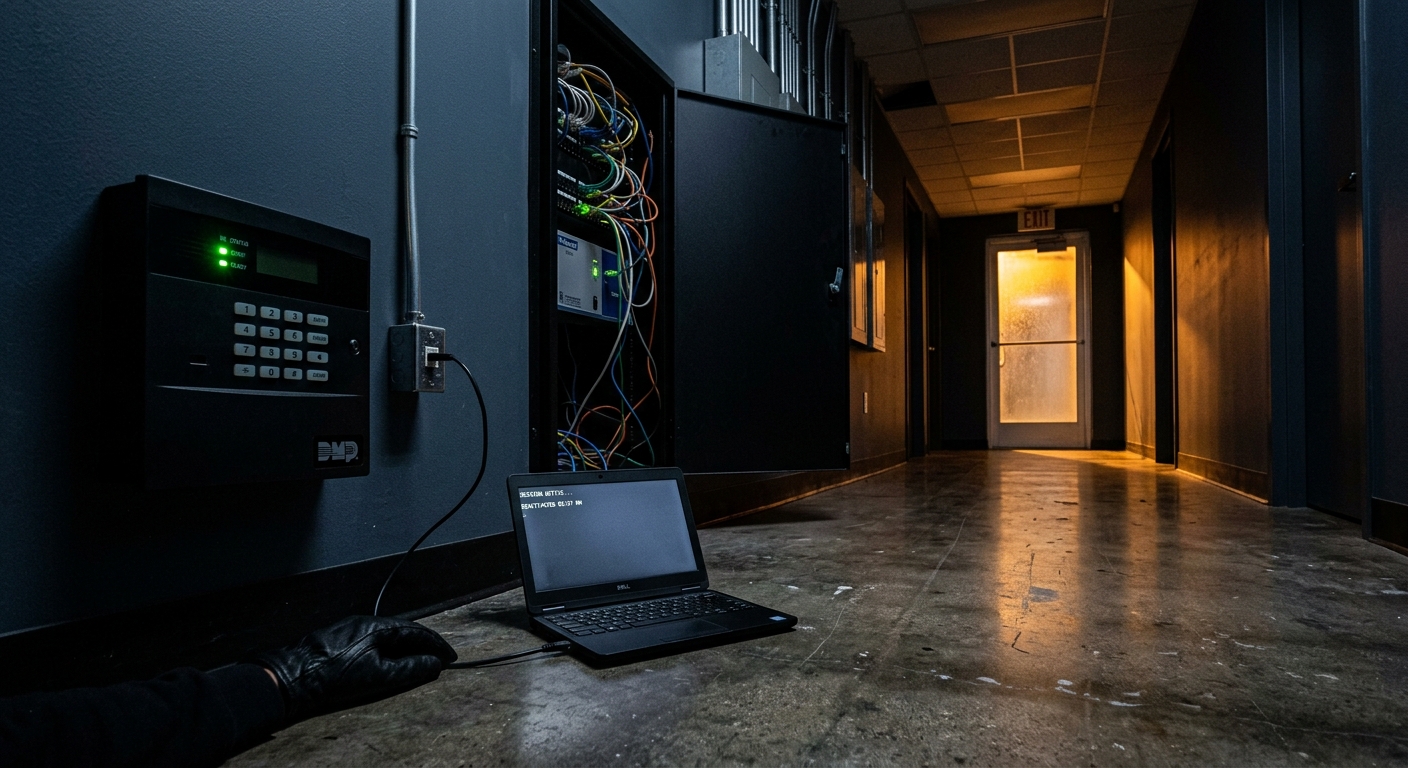
On 6 August 2026, CISA published ICSA-26-218-02 covering the Johnson Controls DSC TL280 internet alarm communicator. The assigned issue, CVE-2026-27871, is titled “Use of Broken or Risky Cryptographic Algorithm.”
The proof of concept described in the public disclosure is about as unambiguous as security research gets: a replayed disarm packet disarmed the panel, without the attacker knowing any keys or user codes.
What the TL280 Does
The TL280 is not the alarm panel. It is the communicator — the module that carries alarm signalling from a DSC intrusion panel over Ethernet to a central station receiver, replacing the phone line that used to do that job. It is compatible with the HS2016, HS2032, HS2064 and HS2128 panel families, and variants add LTE for dual-path signalling so the alarm still reports if the internet connection drops.
In other words, it is the component whose entire reason for existing is trustworthy transport of a small number of extremely consequential messages: armed, disarmed, alarm, trouble, test. Everything else in the intrusion detection system — the sensors, the panel logic, the keypad codes — is only useful if those messages arrive intact and cannot be forged.
Why “Replay” Is the Worst Word Here
A replay attack does not require breaking encryption. The attacker does not need the key, does not need to understand the message format, and does not need to find a memory corruption bug. They capture a valid message once and send it again later.
The defence against replay is well understood and decades old: include something that cannot be reused. A monotonically increasing sequence number, a timestamp within a tight window, a nonce from a challenge-response exchange. Any of those makes a captured packet worthless the second time it is sent. A protocol vulnerable to straightforward replay is one where that machinery is either absent or not properly bound to the message.
The consequence for a building: an attacker positioned to observe the communicator’s traffic — on the same network segment, on a compromised switch, on a device sharing the LAN — can capture the disarm message generated during a legitimate disarm (say, when the office opens at 08:00), then replay it later to disarm the system at a time of their choosing. The panel believes it received a valid instruction. The monitoring station believes the premises were disarmed by an authorised user. The event log records a normal disarm.
That last part matters more than the intrusion itself for anyone who has to reconstruct what happened afterwards.
The Timeline
From the public disclosure record:
- 16 February 2026 — issue reported to VulnCheck
- 18 February 2026 — receipt confirmed; Johnson Controls engaged for CVE assignment
- 6 May 2026 — vendor reproducing the issue; final fix tracking to approximately September/October 2026
- 6 August 2026 — CISA advisory published as ICSA-26-218-02
Roughly eight months from report to expected fix, on a security product. This is not a criticism unique to one vendor — it is characteristic of embedded firmware in the physical security market, where a fix has to be validated against multiple panel generations, certified against alarm industry standards (UL, EN 50131 and the rest), and then delivered to devices installed in thousands of buildings by independent dealers, many of which have no remote update path at all.
That last constraint is the real one. Shipping the firmware is not the same as the firmware being installed, and for a large fraction of the installed base it never will be.
The Structural Problem: Alarm Protocols Were Designed for Phone Lines
Alarm signalling formats have a long lineage. The dominant protocols were designed when the transport was a dedicated telephone circuit, and the threat model was accordingly narrow: the wire could be cut (so you detect line faults), and the wire could conceivably be tapped by someone with physical access to a junction box (which was treated as an acceptable residual risk).
Neither assumption survives the move to IP. The transport is now a shared, routable network reachable from every device in the building and, depending on configuration, from outside it. The set of parties who can observe and inject traffic has gone from “someone with a lineman’s handset” to “any compromised endpoint on the LAN.” The protocols largely did not change to match; the IP communicator wrapped the legacy signalling in a new transport and inherited the old assumptions.
This is the same generational mismatch we keep finding elsewhere in the building stack. It is why a malformed BACnet packet can take out a Desigo controller, and why an access control server ended up with an unauthenticated deserialization bug on a high port. In each case a protocol or architecture that assumed a trusted, physically constrained network was moved onto an ordinary IP network without revisiting the assumption.
What To Do Before the Firmware Arrives
Since the fix is months out and may not reach your installed base quickly, the useful actions are compensating rather than corrective.
- Find out what carries your alarm signalling. Most facilities managers cannot name the communicator model in their panel. Ask your alarm dealer for the model and firmware version in writing, and ask specifically whether it is a TL280 family device.
- Put alarm signalling on its own segment. The communicator should not share a broadcast domain with workstations, guest Wi-Fi, cameras, or anything else. Replay requires the attacker to see the traffic; segmentation is the control that directly addresses that.
- Enable and verify dual-path signalling. If the device supports an LTE path alongside Ethernet, a mismatch between paths becomes a detection opportunity — and it complicates an attack that targets only the IP transport.
- Rely on supervision, not just events. Central station supervision — regular check-in polling with alerting on missed check-ins — detects transport-layer interference in a way that individual event messages do not. Confirm with your monitoring provider what the supervision interval is and what happens when it lapses.
- Do not treat the alarm log as authoritative in an investigation. If a disarm can be forged, the record of a disarm is no longer evidence of a person. Corroborate with an independent source: badge events from the access control system, camera footage stored on the VMS, network authentication logs.
- Layer detection that does not depend on the panel. Camera-based analytics, door position sensors reporting to a different system, or network monitoring on the security VLAN all provide signal that a compromised communicator cannot suppress.
- Ask your dealer the update question now. Specifically: when the firmware ships, does your installation get it automatically, or does it require a truck roll? If a truck roll, get it scheduled provisionally in October rather than negotiating it in December.
The Wider Read
Physical security systems occupy an unusual position. They are bought as security products, which means they are trusted by default. They are installed by specialist contractors, which means IT rarely sees them. They run for fifteen to twenty years, which means the deployed base always trails the current firmware by many generations. And they now sit on IP networks, which means they carry the full modern threat model on top of a protocol design from the phone-line era.
CVE-2026-27871 is a small vulnerability by most scoring conventions. But the failure mode it produces — an alarm system that reports normal while a building is entered, and an event log that agrees — is precisely the failure mode intrusion detection exists to prevent. Worth knowing which communicator is in your panel.