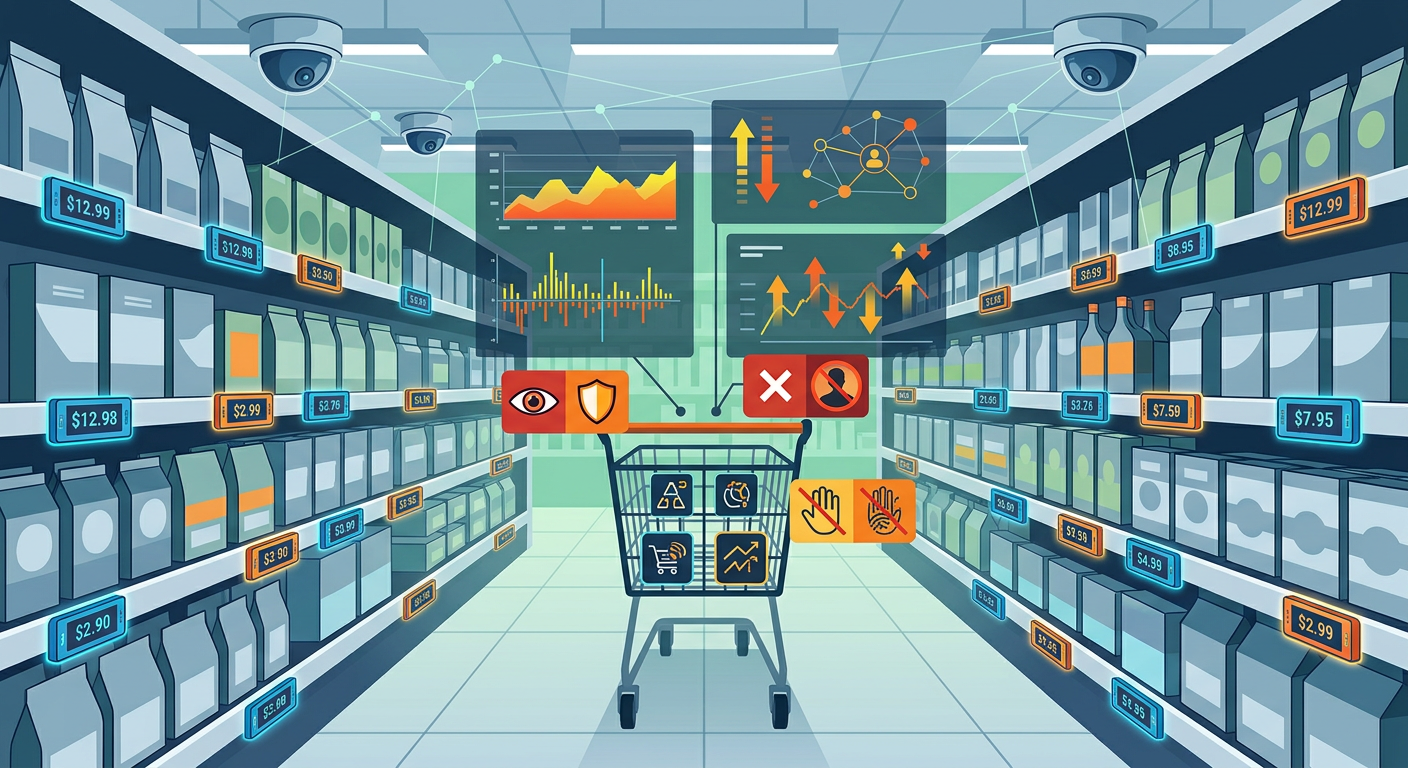
Walk into a Walmart in the next year or two and something will look slightly different on the shelves. Gone are the paper price tags employees swap out with a ladder and a label gun. In their place: small, rectangular digital displays — electronic shelf labels (ESLs) — glowing quietly with a price that can change in seconds, pushed wirelessly from a central system thousands of miles away.
Walmart is rolling out ESLs across all of its U.S. stores. The official story is efficiency: fewer labor hours spent repricing, faster response to supply chain shifts, easier inventory management. All of that is true. But efficiency is only the surface-level pitch. Underneath it is something more consequential — the infrastructure for AI-powered, real-time, and potentially personalized pricing at the largest retailer in the United States.
This matters to consumers. But if you manage office procurement or run a business with any IoT devices on-site, it matters to you for different reasons entirely.
From Paper to Pixels: What ESLs Actually Are
Electronic shelf labels aren’t new technology. Grocery chains in Europe have used them for years. What’s new is the scale — Walmart’s footprint covers roughly 4,700 U.S. stores — and the ambition behind the deployment.
ESLs are small e-ink or LCD displays that communicate via a local wireless network (typically a proprietary RF or Wi-Fi protocol) with a store’s central pricing server. A manager or algorithm pushes a price change; every relevant tag in the store updates within seconds. No physical labor required.
The result is a pricing infrastructure that is, for the first time in physical retail, as agile as e-commerce. And Walmart intends to use it that way.
The Patent Nobody’s Talking About
In 2017, Walmart filed a patent for a system that “dynamically and automatically updates item prices” using algorithms that weigh demand signals, competitor pricing, inventory levels, and shopper behavior. The patent describes a system capable of adjusting prices multiple times per day — or potentially in response to real-time conditions inside the store itself.
Think about what that means. If a product is flying off shelves during a Saturday afternoon rush, the algorithm can quietly tick the price up. If a storm is coming and bottled water demand spikes, the digital tag reacts before any human manager could. If foot traffic in a particular aisle is high, the system knows. This isn’t a theoretical future — it’s a logical extension of infrastructure Walmart is building right now.
Dynamic pricing in retail has been creeping up for years. Amazon reportedly changes prices on its platform approximately 2.5 million times per day. Airlines and hotels have used yield management algorithms for decades. Uber’s surge pricing became a cultural flashpoint. Now that same model is coming to the physical store — where people assumed prices were fixed and equal for everyone.
Your Cereal Might Cost More Than Your Neighbor’s
Here’s where it gets more uncomfortable: the leap from dynamic pricing to personalized pricing is shorter than most people realize.
Dynamic pricing changes prices based on demand and time. Personalized pricing changes prices based on who you are — or more precisely, what the algorithm thinks you can pay and how likely you are to buy. It’s algorithmic price discrimination, and it already exists in various forms online. Insurance quotes, rental car rates, flight prices — they often vary based on device type, location, browsing history, and account data.
Walmart has the data architecture to do this in physical retail. Walmart+ membership, Walmart Pay, the Walmart app, location tracking, and years of purchase history all feed into a customer data ecosystem that is deeply detailed. The company knows what you buy, how often, in which stores, and increasingly, what else you do on your device when you’re near one of their locations.
The practical scenario looks like this: your Walmart+ account is linked to your phone. You walk into the store. The system recognizes your device via the app. Based on your purchase history and inferred income bracket, the price displayed for a box of cereal — to you, on your app, or potentially on a smart cart display — differs from what someone else sees. They pay $5. You pay $8. The shelf tag shows the base price, but your checkout total tells a different story.
Walmart hasn’t announced personalized pricing at checkout. But the pieces are there, and several retailers globally have experimented with precisely this model. The ESL rollout is the infrastructure investment that makes it operationally possible.
Where Your Data Actually Goes
People sign up for Walmart+ thinking about free shipping and discounts. What they’re also doing is enrolling in a detailed behavioral profiling program. That’s not hyperbole — it’s the economic logic of every loyalty program at scale.
Your data — purchase history, location check-ins, browsing patterns on Walmart.com, payment method preferences, app interactions — feeds into pricing and demand models. The explicit purpose is to “improve your experience” and “offer relevant deals.” The implicit purpose is to maximize revenue extraction from each customer segment.
This is the data economy in practice. Your shopping data isn’t a byproduct of using Walmart’s services. It is the product. The ESL rollout accelerates Walmart’s ability to act on that data in real time, in the physical world, in ways that weren’t previously possible with paper tags.
The IoT Security Layer Everyone Is Missing
For most of the coverage on Walmart’s ESL rollout, the conversation stops at consumer privacy. That’s important, but there’s an entire additional risk surface here that office managers and IT security professionals should be paying attention to.
Every electronic shelf label is a connected IoT device. Multiply that by the tens of thousands of SKUs in a single Walmart Supercenter, and you have a massive fleet of wireless endpoints, each with its own firmware, each requiring ongoing patch management, each communicating on a network that is also connected — directly or indirectly — to point-of-sale systems and inventory databases.
Consider the attack surface:
Firmware vulnerabilities. ESL vendors — companies like Pricer, SES-imagotag, and Hanshow — ship firmware updates on their own cadence. Retailers deploying hundreds of thousands of these devices face the same patch management problem that every IoT-heavy enterprise faces: too many endpoints, too infrequent updates, too little visibility into what’s actually running.
Rogue price manipulation. A threat actor who gains access to the ESL management network could theoretically push false prices across an entire store — creating chaos, enabling fraud at checkout, or simply undermining trust in the retailer’s systems. In 2023, security researchers demonstrated vulnerabilities in ESL protocols used by major European retailers, including the ability to remotely update tags without authorization.
POS system integration. Pricing algorithms don’t live in a vacuum. They interface with point-of-sale systems, which touch transaction data. The more tightly integrated the ESL infrastructure is with POS and loyalty systems, the larger the blast radius of any compromise.
For your own facilities: If you manage an office, warehouse, or retail environment that is considering ESL technology for internal inventory or asset management, these same risks apply. IoT pricing or labeling infrastructure requires vendor security assessments, network segmentation, and a patch management policy before deployment — not after.
The Legal Gap
The European Union has been moving toward requiring transparency in personalized pricing. Under existing EU consumer protection law, businesses that use personalized pricing based on automated profiling are required to disclose it. The EU’s proposed Digital Fairness Act goes further, aiming to restrict certain forms of algorithmic price discrimination entirely.
In the United States, the legal guardrails are minimal. There is no federal law requiring retailers to disclose when prices are personalized or algorithmically determined. Some state consumer protection laws could theoretically apply, but enforcement is spotty and the legal theory is largely untested for retail pricing specifically.
The result: American consumers will likely be subject to AI-driven dynamic and personalized pricing in physical stores with no notification, no right to opt out, and no clear recourse if they suspect discrimination.
What Businesses Should Do
If you’re an office procurement manager, a facilities director, or a business owner who buys supplies from any large retailer — including Walmart — here’s what this shift means practically.
Track prices over time. Dynamic pricing means the “best time to buy” is a real variable now, not just for airline tickets. Tools that log historical price data for common office supplies can help you identify patterns and time purchases strategically.
Use corporate contracted accounts. Many large retailers offer business accounts with negotiated pricing tiers. These contracts often lock in prices for specified periods, which provides insulation from real-time algorithmic swings. If you’re purchasing at consumer rates, you’re more exposed to dynamic pricing.
Audit your own IoT inventory infrastructure. If your organization is considering ESL or RFID-based pricing or inventory systems for your own facilities, treat them as the IoT devices they are. Require vendors to provide a software bill of materials (SBOM), commit to a patch cadence, and ensure these devices are network-segmented from your primary business systems. The same device class that Walmart is deploying can be purchased for internal warehouse or office supply management — and the same risks follow.
Review data-sharing agreements with retail loyalty programs. Understand what data your corporate purchasing accounts share with retailers, and whether that data feeds into pricing models. In a world of personalized pricing, corporate accounts with large purchase volumes are particularly attractive data sources.
Monitor the legal landscape. As EU regulations on personalized pricing tighten, U.S. companies with European operations or customers will face compliance questions. And U.S. state legislation on algorithmic pricing transparency is an area to watch — California, in particular, has historically led on consumer data protection.
The Bottom Line
Walmart’s ESL rollout is not just a logistics upgrade. It is the physical world’s entry into the era of real-time algorithmic pricing — the same model that has dominated e-commerce, travel, and ride-sharing for years, now landing on the shelves where Americans buy their groceries, their office supplies, and their household basics.
The data ecosystem that powers this — your purchase history, your app location data, your Walmart+ profile — exists to help the algorithm maximize what it can extract from you. That’s not a conspiracy theory. It’s the stated purpose of yield management applied to retail.
For office managers and IT security professionals, the additional takeaway is structural: electronic shelf labels are IoT devices, they carry the same risks as any connected endpoint fleet, and the pricing infrastructure they support is increasingly integrated with transaction systems. Understanding that risk is the first step to managing it.
The price tag always had a number on it. Now the number knows who you are.


