15 Security Incidents at US Military Bases in 18 Days: Drones, Bombs, and Breach Attempts During a Hot War
Since the U.S.-Israeli air war against Iran began on February 28, 2026, at least 15 security incidents have been reported at U.S. military installations across the continental United States. The pattern is unprecedented in modern peacetime — and we’re not at peace.
Drones over nuclear bomber flightlines. Bomb threats at the headquarters of U.S. Central Command. Suspicious packages at gates from New Jersey to Florida. An intruder entering a naval air station by boat. Possible explosives detected at a missile facility entrance. And that’s just what’s been made public.
The question isn’t whether these incidents are connected. The question is who is probing, what they’re learning, and what comes next.
The Timeline: Every Known Incident
Here is the complete chronology of publicly reported security events at U.S. military bases since the Iran war began:
| Date | Installation | State | Incident |
|---|---|---|---|
| Feb 28 | Kirtland AFB | NM | Armed person on base |
| Mar 1 | Shaw AFB | SC | Threat at Sumter gate |
| Mar 2 | NAS Pensacola | FL | Unauthorized subject entered base by boat |
| Mar 3 | Ellsworth AFB | SD | Multiple security incidents over/near flightline |
| Mar 6 | Selfridge ANGB | MI | Suspicious package |
| Mar 9 | Barksdale AFB | LA | Lockdown — drone over flightline |
| Mar 10 | Moody AFB | GA | Lockdown — security incident |
| Mar 11 | Tyndall AFB | FL | Suspicious package |
| Mar 12 | MacDill AFB | FL | Suspicious package — FBI bomb techs called |
| Mar 13 | Beale AFB | CA | Unauthorized drone |
| Mar 17 | JB McGuire-Dix-Lakehurst | NJ | Suspicious packages — FPCON Charlie issued |
| Mar 17 | Holloman AFB | NM | Shooting (domestic) |
| Mar 18 | Sheppard AFB | TX | Possible explosives detected at Missile gate |
| Mar 18 | MacDill AFB | FL | Bomb threat — shelter-in-place issued |
| Mar 18 | MacDill AFB | FL | Second bomb threat — ongoing as of publishing |
That’s 15 incidents in 18 days, across 12 different installations, spanning 9 states. Three of these involved MacDill AFB alone — home to U.S. Central Command (CENTCOM), which is actively directing military operations in the Iran war.
The Pattern: What Stands Out
1. The Drone Problem Is Real
Two confirmed drone incidents — at Barksdale AFB (home to three squadrons of B-52 nuclear-capable bombers) and Beale AFB (home to U-2 and RQ-4 Global Hawk reconnaissance aircraft) — represent the most operationally significant threats in the timeline.
Barksdale AFB (March 9): A drone was detected over or near the flightline, prompting an immediate shelter-in-place order. Barksdale houses the 2nd Bomb Wing and 307th Bomb Wing, operating B-52H Stratofortress aircraft — the backbone of America’s airborne nuclear deterrent. Penalties for approaching Barksdale’s restricted airspace have recently been increased.
Beale AFB (March 13): An unauthorized drone was reported at this Northern California base, which houses the 9th Reconnaissance Wing — operating U-2 Dragon Lady and RQ-4 Global Hawk surveillance aircraft that are likely actively supporting intelligence gathering over Iran.
A drone over a nuclear bomber base and a drone over the reconnaissance wing supporting active combat operations. These aren’t hobbyists.
2. MacDill Is Being Specifically Targeted
Three separate incidents in six days at MacDill AFB — the home of U.S. Central Command:
- March 12: Suspicious package turned over to FBI bomb technicians
- March 18 (morning): Bomb threat, shelter-in-place issued
- March 18 (afternoon): Second bomb threat while still under FPCON Charlie
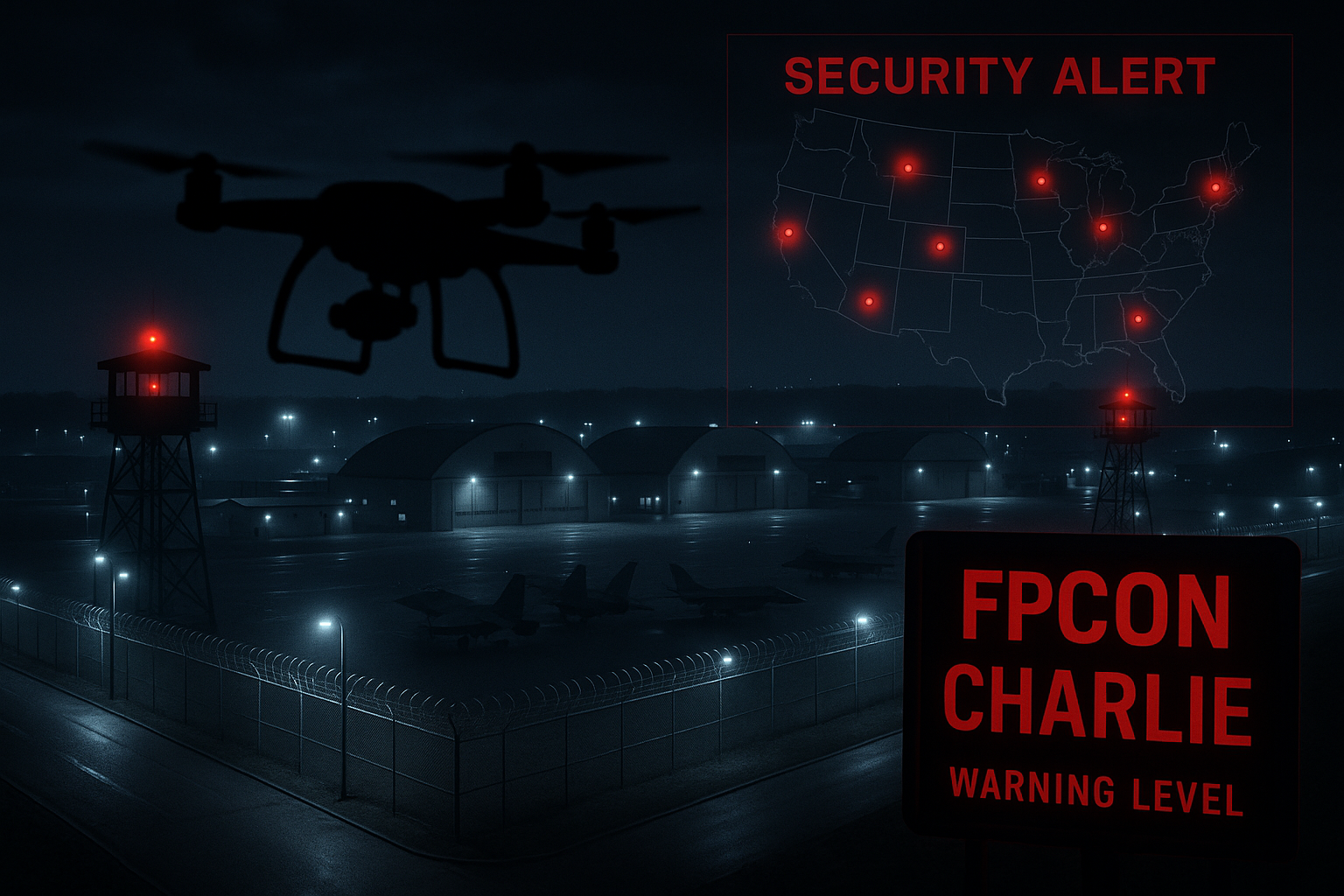
MacDill raised its Force Protection Condition to FPCON Charlie on March 18 — the second-highest threat level, indicating “an incident occurs or intelligence is received indicating some form of terrorist action or targeting against personnel or facilities is likely.”
CENTCOM is directing the war against Iran from MacDill. The repeated targeting of this specific installation during active combat operations is not coincidental.
3. The Geographic Spread Is Deliberate
The incidents aren’t clustered in one region. They span from New Jersey to California, from South Dakota to Florida. The installations targeted include:
- Nuclear bomber bases (Barksdale, Ellsworth)
- Reconnaissance assets (Beale)
- Combatant command headquarters (MacDill/CENTCOM)
- Training bases (Sheppard, Tyndall)
- Joint bases (McGuire-Dix-Lakehurst)
- Naval air stations (NAS Pensacola)
- Air National Guard (Selfridge)
This distribution suggests either coordinated probing across the force structure or — at minimum — a threat environment that has elevated risk at every category of military installation simultaneously.
4. The Entry Methods Are Varied
The incidents include:
- Aerial intrusion (drones at Barksdale and Beale)
- Maritime intrusion (unauthorized entry by boat at NAS Pensacola)
- Gate-level threats (suspicious packages, possible explosives, bomb threats)
- Armed individuals (Kirtland)
- Flightline proximity (Ellsworth, Barksdale)
Multiple vectors. Multiple installations. Multiple states. This is what structured reconnaissance looks like.
The Chinese Farmland Factor
While the immediate security incidents dominate the headlines, a slower-burning physical security threat compounds the picture: Chinese-linked companies own approximately 277,336 acres of U.S. agricultural land — and an alarming amount of it is positioned near military installations.
The Grand Forks Case
The most prominent example: in 2022, the Fufeng Group, a Chinese-owned company, purchased land in Grand Forks, North Dakota — just 12 miles from Grand Forks Air Force Base, which hosts the 319th Reconnaissance Wing and is critical to the U.S. military’s drone and surveillance operations. After intense national security scrutiny, the deal was eventually blocked following intervention from CFIUS (Committee on Foreign Investment in the United States) and the Department of Defense.
Utah Forces Divestiture
As recently as February 2026, Utah Governor Spencer Cox announced that a Chinese-linked company had divested land located near key U.S. military installations following state pressure. Cox described it as a “major national security victory.”
The Legislative Response
Multiple states are now advancing legislation to restrict foreign adversary land purchases near military facilities:
- North Carolina: The proposed Farmland and Military Protection Act would block purchases by adversarial foreign governments near bases
- Utah: Already forced divestiture
- Multiple other states: Similar bills advancing through legislatures
Why Proximity Matters for Physical Security
Land near military bases provides:
- Line of sight for visual and electronic surveillance
- Staging areas for drone operations
- Signal intelligence collection positions (monitoring communications, radar emissions, flight patterns)
- Cover for persistent observation under the guise of agricultural operations
- Infrastructure for future operations — buildings, power, communications
The USDA’s Agricultural Foreign Investment Disclosure Act (AFIDA) tracks foreign land holdings, but enforcement has historically been weak and the data is often outdated. The map of Chinese-owned farmland overlapping with military installation locations is concerning precisely because it represents a persistent physical intelligence collection capability that exists regardless of the current conflict.
FPCON Charlie: What It Means
Multiple bases have elevated to Force Protection Condition Charlie — the second-highest level in the FPCON system:
| Level | Meaning |
|---|---|
| Normal | Routine security |
| Alpha | Increased threat, general in nature |
| Bravo | Increased, more predictable threat |
| Charlie | Incident occurred or intelligence indicates likely attack on personnel/facilities |
| Delta | Imminent or ongoing attack |
FPCON Charlie triggers:
- 100% ID checks at all entry points
- Access restricted to essential personnel only
- Potential gate closures
- Enhanced security force presence
- Increased surveillance and patrol activity
- Bag inspections and vehicle searches
The elevation to FPCON Charlie at multiple bases simultaneously during an active war is itself a signal that defense intelligence assesses the domestic threat as real and imminent.
The Iran Connection
The timing cannot be separated from the conflict:
- The war with Iran began February 28 — the same day the first incident (Kirtland AFB) occurred
- The IRGC has explicitly declared U.S. military assets as legitimate targets
- Iranian cyber operations have already targeted American infrastructure (Stryker attack, financial sector targeting)
- The 245% increase in cyberattacks documented by Akamai includes reconnaissance of U.S. defense infrastructure
Whether these physical security incidents are directly orchestrated by Iranian intelligence, inspired by the conflict environment, or opportunistic probing by other actors taking advantage of the chaos — the operational effect is the same: U.S. military installations are under pressure from multiple vectors simultaneously while actively conducting combat operations.
What Organizations Near Military Bases Should Do
If your business operates near a U.S. military installation — and especially if you’re in the defense industrial base:
Physical Security
- Review your perimeter security immediately. Drone detection, camera coverage, access control
- Brief employees on reporting suspicious activity — surveillance, photography, drone activity, unfamiliar vehicles conducting reconnaissance
- Coordinate with base security if you observe anything unusual
- Review land ownership around your facilities using county assessor records
Cybersecurity
- Assume elevated threat to networks that connect to or support military operations
- Monitor for reconnaissance — scanning, probing, credential harvesting attempts
- Segment networks that have any connection to defense contracts or military communications
- Update incident response plans to account for combined physical-cyber attack scenarios
Drone Defense
- Document any drone activity near your facilities — time, direction, duration, estimated size
- Report immediately to local law enforcement AND the nearest military installation’s security office
- Consider drone detection systems if your facility handles sensitive defense work
- Review airspace around your location for temporary flight restrictions (TFRs)
The Bottom Line
Fifteen security incidents at twelve military installations in eighteen days — during an active war — is not normal. The combination of drone intrusions at nuclear bomber and reconnaissance bases, repeated bomb threats at CENTCOM headquarters, and the broader context of Chinese land proximity and Iranian cyber escalation paints a picture of U.S. military installations under multi-vector pressure.
The physical security dimension of the Iran war isn’t happening overseas. It’s happening at air force bases in Louisiana, Florida, California, and Texas. And the question every security professional should be asking: if this is what’s happening at military installations with armed guards, fences, and FPCON Charlie — what’s happening at the defense contractors, utilities, and critical infrastructure facilities with far less protection?
Sources
- WUSF, “Shelter in place lifted at MacDill Air Force Base following threat,” March 18, 2026
- Newsweek, “MacDill Air Force Base under shelter-in-place after security threat,” March 18, 2026
- FOX 13 Tampa Bay, “MacDill Air Force Base issues shelter in place for security threat,” March 18, 2026
- Shreveport Times, “Reported drone prompts Barksdale Air Force Base shelter in place,” March 9, 2026
- The Debrief, “U.S. Officials Investigating Mystery Drone Incident Over Barksdale Air Force Base,” March 2026
- Daily Mail, “Mystery drone triggers terror alert at major US Air Force base home to nuclear strike bomber,” March 2026
- NBC10 Philadelphia, “Joint Base McGuire-Dix-Lakehurst under increased security measures,” March 2026
- USDA, Agricultural Foreign Investment Disclosure Act (AFIDA) data
- Epoch Times / USDA AFIDA, “China Owns 277,336 Acres of US Farmland”
- YourNews, “Utah Forces Chinese-Linked Company to Sell Land Near Military Sites,” February 2026
- Ask a Prepper, “The Secret Chinese Farms on US Soil,” March 2026